
Pandemic modeling uses statistical tools and data to help you understand how diseases spread and evaluate control strategies. These models predict how quickly a virus can infect populations and which groups are most at risk. They incorporate factors like contact patterns, vaccination plans, and human behavior to guide public health decisions. By simulating different scenarios, you can see how interventions might slow or stop transmission. Keep exploring to discover more about how these models inform our responses to outbreaks.
Key Takeaways
- Pandemic models simulate how diseases spread through populations using statistical data on transmission, contact patterns, and infection rates.
- They utilize frameworks like SIR models to predict infection trajectories and identify high-risk groups.
- Models incorporate behavioral responses and vaccination strategies to assess their impact on disease dynamics.
- Real-time data updates enable models to adapt to new variants and changing circumstances for accurate forecasts.
- These statistical insights guide public health policies to optimize interventions and resource allocation to control outbreaks.
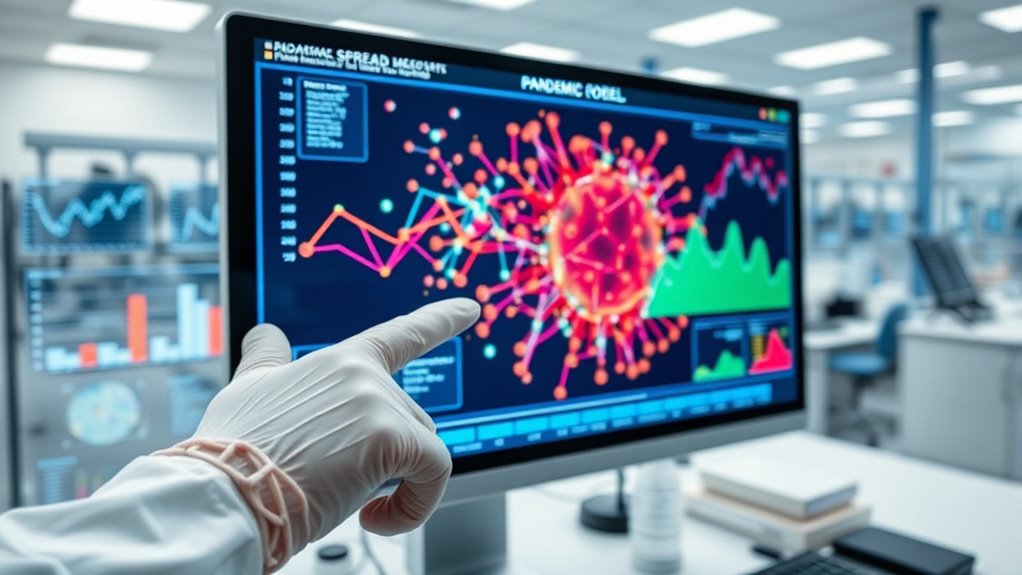
Pandemic modeling plays an essential role in understanding and controlling the spread of infectious diseases. When a new virus surfaces, modeling helps predict how quickly it might spread, which populations are most at risk, and what measures can effectively slow or halt transmission. By simulating different scenarios, you can see how behavioral interventions—like social distancing, mask-wearing, and quarantine—impact infection rates. These models account for how people behave and interact, giving you a clearer picture of how individual actions influence the broader outbreak. This insight allows public health officials to craft targeted messaging and policies that encourage behaviors proven to reduce transmission.
Pandemic models reveal how behavioral interventions influence infection spread and guide effective public health strategies.
Vaccination strategies are another crucial element that pandemic models incorporate. They help determine the most effective way to deploy vaccines to achieve herd immunity efficiently. For instance, models can analyze the effects of prioritizing certain groups—such as healthcare workers, the elderly, or high-contact individuals—to maximize the impact of limited vaccine supplies. By simulating different rollout plans, you can identify which strategies most effectively curb the disease’s spread and reduce hospitalizations and deaths. This allows decision-makers to allocate resources wisely and implement vaccination campaigns that are both timely and effective.
As you explore these models, you’ll notice they rely heavily on data—such as infection rates, transmission probabilities, and population density—to produce accurate predictions. The models often use compartmental frameworks, like the classic SIR (Susceptible-Infected-Recovered), to categorize populations and track how individuals move between health states over time. Advanced models may incorporate more complex factors, including behavioral responses to public health messaging or vaccine acceptance rates. These nuances help create a detailed picture of potential outcomes, guiding interventions before a crisis escalates.
Moreover, pandemic modeling isn’t static; it evolves as new data becomes available. You can use real-time information to update your models, ensuring that your response adapts to changing circumstances. For example, if a new variant emerges, models can be adjusted to assess how it might alter transmission dynamics and the effectiveness of existing interventions. This flexibility is crucial for a swift, informed response, allowing authorities to modify behavioral interventions or vaccination strategies accordingly.
In essence, pandemic modeling equips you with a powerful tool to anticipate and influence disease trajectories. By understanding how behavioral interventions and vaccination strategies interact within these models, you can make smarter decisions that save lives and mitigate societal disruptions. It’s a continuous process—learning from data, refining strategies, and staying ahead of the virus’s course—making it an indispensable part of modern public health planning. Recognizing the importance of curiosity-driven exploration and ongoing learning enhances your ability to adapt and respond effectively to evolving health crises.
Frequently Asked Questions
How Accurate Are Pandemic Models in Predicting Future Outbreaks?
Pandemic models can be quite helpful, but their accuracy varies because of model uncertainty and data reliability issues. You should remember that models are based on current data, which might be incomplete or biased. As a result, predictions can shift as new information emerges. While models give valuable insights, you shouldn’t rely on them as precise forecasts, but rather as tools to guide responses and prepare for potential outbreaks.
What Are the Main Limitations of Current Disease Spread Models?
You face flaws in disease spread models that falter with faulty data and fuzzy parameters. Data reliability can be doubtful, leading to distorted predictions. Parameter uncertainty adds ambiguity, making models less precise. These limitations cloud clarity, complicate decision-making, and challenge confidence. While models endeavor to simulate reality, they often stumble on uncertain variables and unreliable information, leaving you with an imperfect picture of potential outbreaks.
How Do Models Account for Vaccination Effects?
You should know that models incorporate vaccination effects by including vaccine efficacy data, which shows how well vaccines prevent infection or transmission. They also factor in vaccination rates to estimate herd immunity thresholds. This helps predict how vaccination coverage can slow or stop disease spread. By adjusting these parameters, models can simulate different scenarios, guiding public health decisions and showing the potential impact of vaccination campaigns on controlling outbreaks.
Can Models Predict the Impact of New Virus Mutations?
While predicting the exact course of new mutations can be challenging, models do incorporate genetic variability and mutation tracking to estimate potential impacts. You should recognize that these models analyze mutation patterns and monitor genetic changes, helping you anticipate how new virus variants might influence spread and severity. Although not foolproof, this approach enables you to stay informed about evolving risks and prepare adaptive responses accordingly.
How Is Real-Time Data Incorporated Into Ongoing Pandemic Models?
You incorporate real-time data into ongoing pandemic models through real-time surveillance, which continuously gathers current information like infection rates and hospitalizations. Data assimilation techniques then update the models with this fresh data, refining predictions and improving accuracy. This process allows you to respond swiftly to new developments, making your pandemic models more reliable for decision-making and public health interventions.
Conclusion
As you grasp the power of pandemic modeling, you’ll see how numbers reveal hidden patterns and guide essential decisions. Just as a map directs a traveler through unknown terrain, statistical insights navigate us through uncertainty. While models can’t predict every twist, they illuminate possible paths forward. Understanding this balance between certainty and unpredictability helps you appreciate the critical role of data in controlling disease spread—showing that sometimes, the smallest numbers can have the biggest impact.