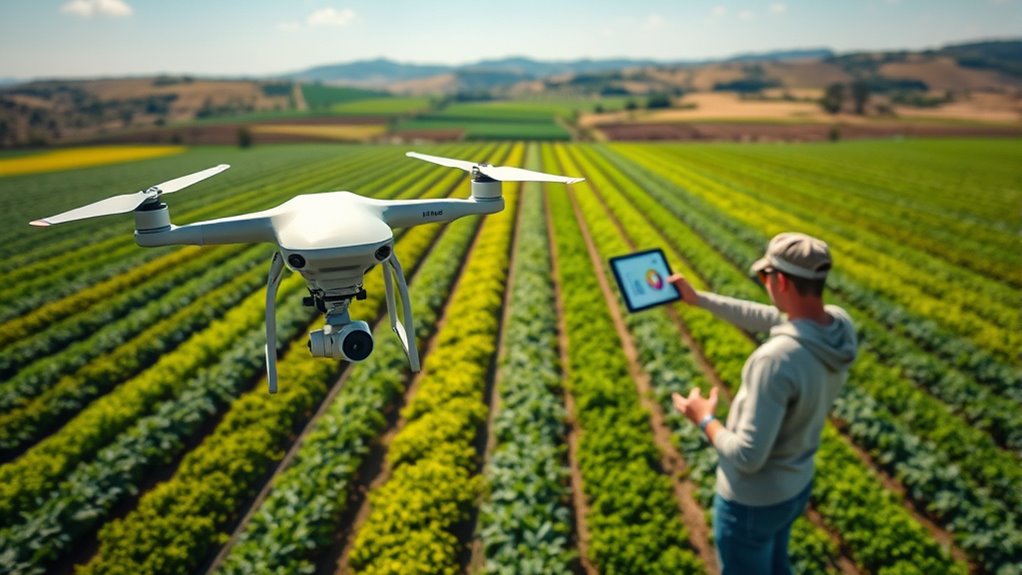

By analyzing climate and soil data, you can optimize your crop selection and planting schedules for better yield predictions. Climate patterns inform you when to plant drought-resistant varieties or adjust timing for rainfall irregularities. Soil analysis helps identify nutrient deficiencies and land constraints, guiding fertilization and land management. Combining these insights allows for more precise scheduling and sustainable practices. Keep exploring how data-driven planning can boost your farm’s productivity and resilience.
Key Takeaways
- Integrate climate data and soil analysis to create comprehensive models for accurate yield predictions.
- Use weather forecasts and soil nutrient information to optimize planting schedules and resource application.
- Employ predictive software tools and scenario simulations to estimate crop outcomes under varying environmental conditions.
- Monitor seasonal trends and climate impacts to adjust crop choices, planting times, and management practices proactively.
- Apply data-driven insights to enhance sustainability, reduce waste, and improve overall crop yield reliability.
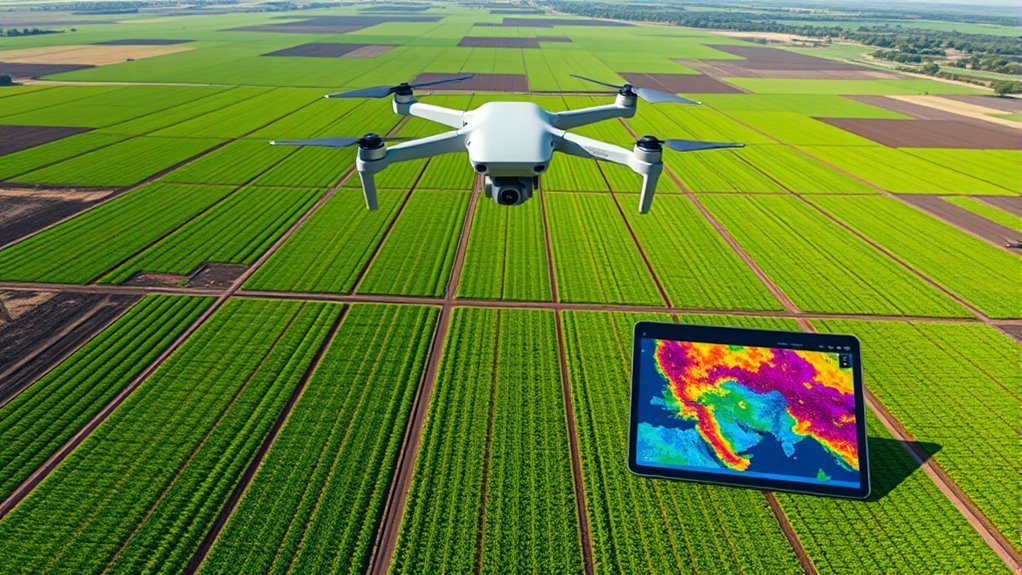
Have you ever wondered how farmers decide what crops to plant and when? It’s a complex process that relies heavily on data, especially in today’s changing climate. Understanding the climate impact is essential because it influences crop selection, planting schedules, and overall yield expectations. Farmers analyze recent weather patterns, temperature fluctuations, rainfall levels, and seasonal trends to determine which crops will thrive under current conditions. For example, if data shows increased temperatures or irregular rainfall, they might choose drought-resistant varieties or adjust planting dates to reduce risks. This proactive approach helps guarantee crops grow successfully despite unpredictable weather, making the planning process more resilient.
Equally significant is soil analysis, which provides critical information about the land’s health and fertility. Before planting, farmers evaluate soil composition, pH levels, nutrient content, and organic matter. This data helps them decide which crops are best suited for their land and what amendments or fertilizers might be necessary. For instance, if soil tests reveal deficiencies in nitrogen or phosphorus, farmers can add targeted fertilizers to maximize growth. Soil analysis also helps identify potential constraints, like poor drainage or compacted soil, allowing farmers to implement strategies that improve conditions and boost yields. In this way, combining climate impact data with detailed soil analysis creates an extensive picture that guides planting decisions, reducing waste and maximizing productivity.
Using data-driven insights, farmers can create detailed planting schedules that align with ideal climate conditions and soil health. This planning minimizes the risk of crop failure and enhances yield predictability. They often utilize software tools and predictive models that incorporate weather forecasts, historical climate data, and soil test results. These tools enable them to simulate different scenarios and choose the best time to sow seeds, irrigate fields, and apply fertilizers. By doing so, they adapt to changing environmental factors and improve their chances of a successful harvest. This level of precision in agricultural planning not only boosts efficiency but also supports sustainable practices by reducing unnecessary input use and environmental impact.
soil test kit for farmers
As an affiliate, we earn on qualifying purchases.
As an affiliate, we earn on qualifying purchases.
Frequently Asked Questions
How Accurate Are Crop Yield Predictions Based on Current Data?
Crop yield predictions based on current data are quite accurate when you incorporate historical weather and soil composition. These factors help refine models, reducing uncertainty. You can expect predictions to be reliable within a certain margin, but they might still vary due to unforeseen weather events or soil changes. Overall, by continuously updating your data, you improve the accuracy, enabling better planning and resource allocation for your farm.
What Types of Data Are Most Critical for Reliable Forecasting?
Think of forecasting crop yields as steering a river; the most essential data are your compass and map. Soil moisture tells you how well your boat floats, while pest infestations can sink your progress. Accurate predictions depend on these critical data points, along with weather patterns and crop health. By focusing on soil moisture and pest data, you steer your agricultural plans toward a more reliable and successful harvest.
How Can Farmers Access Predictive Analytics Tools Effectively?
You can access predictive analytics tools effectively by enhancing your digital literacy and seeking farmer education programs. Many platforms offer user-friendly interfaces and tutorials tailored for farmers. Join online workshops or local training sessions to build your skills. Additionally, collaborate with agricultural extension services or tech providers that offer support. Staying informed about new tools and practicing regularly helps you leverage data-driven insights to optimize your crop yields.
What Are Limitations of Data-Driven Agricultural Planning?
A stitch in time saves nine, but data-driven planning isn’t foolproof. You might face limitations like data privacy concerns, which restrict access and sharing of critical info. Technology biases can skew predictions, leading you to poor decisions. Additionally, incomplete or inaccurate data hampers reliability. You need to recognize these hurdles and work towards transparent, unbiased data collection and privacy safeguards to make the most of predictive analytics in agriculture.
How Does Climate Change Impact Crop Yield Predictions?
Climate change affects your crop yield predictions by increasing climate variability and drought frequency. These factors make weather patterns less predictable, causing you to struggle with accurate forecasts. You may face sudden droughts or unexpected storms, which can drastically reduce yields. Relying solely on historical data becomes less effective as climate patterns shift, forcing you to incorporate real-time climate data and adapt your planning strategies to manage risks effectively.
weather forecast agricultural software
As an affiliate, we earn on qualifying purchases.
As an affiliate, we earn on qualifying purchases.
Conclusion
By harnessing data, you turn the seeds of possibility into a harvest of certainty. Like a skilled navigator guiding through a storm, your insights steer you toward bountiful crops and prosperous seasons. Remember, in this dance with nature, data is your steady rhythm—helping you predict, prepare, and flourish. With every prediction, you plant the seeds for a future where your fields thrive, and abundance blossoms from the choices you make today.
crop yield prediction tools
As an affiliate, we earn on qualifying purchases.
As an affiliate, we earn on qualifying purchases.
drought-resistant crop seeds
As an affiliate, we earn on qualifying purchases.
As an affiliate, we earn on qualifying purchases.