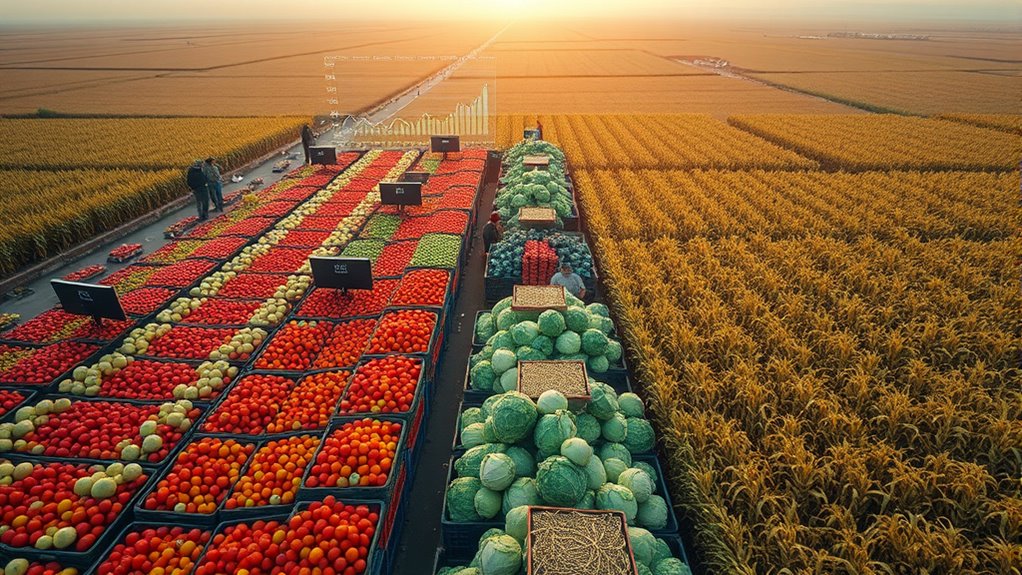

Agricultural market analytics help you forecast crop yields and prices by combining climate data, satellite imagery, and advanced sensors. These tools analyze current environmental conditions and use machine learning to identify patterns, giving you more accurate predictions. Incorporating climate impacts guarantees your forecasts reflect real-world conditions, helping you plan effectively and minimize risks. If you want to discover how these technologies work together, there’s much more to explore below.

Get business pricing on monitors, keyboards and dev gear
- Business-only prices and quantity discounts
- Tax-exempt purchasing
- Multiple users, one account, clear invoices
Key Takeaways
- Utilize predictive analytics models that incorporate climate, weather, and soil data to estimate future crop yields and prices.
- Leverage remote sensing and sensor technologies for real-time environmental monitoring to improve forecast accuracy.
- Apply scenario modeling to evaluate impacts of weather events, droughts, and climate change on market outcomes.
- Integrate big data analytics and machine learning to analyze market trends and enhance decision-making.
- Use climate impact insights to develop resilient strategies, reducing risks and optimizing profitability in agricultural markets.

Have you ever wondered how farmers and traders make informed decisions in today’s complex agricultural markets? The answer lies in the power of agricultural market analytics, which harness data to forecast crop yields and prices accurately. In recent years, technological innovation has revolutionized this process, enabling stakeholders to analyze vast amounts of information quickly and efficiently. One critical factor that influences these analytics is the climate impact. Shifts in weather patterns, droughts, floods, and temperature changes directly affect crop production, making it essential to incorporate climate data into predictive models. By understanding how climate impacts crop growth, farmers can better plan planting schedules, select resilient varieties, and implement adaptive strategies to mitigate risks. Traders, on the other hand, use this information to anticipate supply fluctuations and adjust their buying or selling strategies accordingly. Technological innovation has made it easier than ever to integrate climate impact data into detailed analytics systems. Advanced sensors, satellite imagery, and remote sensing technologies collect real-time environmental data, providing detailed insights into current conditions. Machine learning algorithms process this information to identify patterns and forecast future outcomes, such as potential yield reductions due to adverse weather events. These innovations allow for more precise predictions, giving farmers and traders a competitive edge. additionally, digital platforms now compile weather forecasts, soil health data, and market trends into user-friendly dashboards. This integration helps you make timely decisions, whether that’s deciding when to plant, harvest, or sell your produce. The use of big data analytics enables a more holistic understanding of how climate factors intertwine with market dynamics, enhancing your ability to respond proactively rather than reactively. You can also leverage predictive analytics to model different scenarios, such as what might happen if a drought persists or if a new weather pattern emerges. This foresight helps you allocate resources more effectively and minimize financial risks. Overall, the combination of climate impact insights and technological innovation in agricultural market analytics empowers you to navigate uncertainties with greater confidence. It’s about transforming raw environmental and market data into actionable intelligence that supports sustainable farming practices and profitable trading strategies. As technology continues to evolve, expect even more sophisticated tools that will provide deeper insights and more accurate forecasts. Embracing these advancements means you’re better equipped to adapt to climate challenges and market volatility, ensuring your operations remain resilient and profitable in an ever-changing agricultural landscape. Additionally, integrating data analysis methods like machine learning can further enhance the accuracy of crop yield and price predictions.
satellite imagery for crop monitoring
As an affiliate, we earn on qualifying purchases.
As an affiliate, we earn on qualifying purchases.
Frequently Asked Questions
How Accurate Are Crop Yield Forecasts Across Different Regions?
Crop yield forecasts vary across regions, but satellite imagery and soil moisture data considerably improve their accuracy. You can rely on these tools to monitor crop health and environmental conditions in real-time, helping you make informed decisions. While some areas may still face uncertainties due to weather or data limitations, integrating these technologies generally leads to more precise predictions tailored to each region’s unique conditions.
What Factors Most Influence Agricultural Price Fluctuations?
You might think prices are steady, but they’re wildly influenced by supply chain disruptions and government policies that can flip the market overnight. When transport halts or policies change suddenly, prices skyrocket or plummet in an instant. These factors disrupt supply and demand, making prices swing dramatically. So, you need to stay alert, because these forces are the real puppeteers pulling the strings behind agricultural price fluctuations.
How Can Farmers Access Real-Time Market Analytics Data?
You can access real-time market analytics data through mobile applications designed for farmers, which often feature data visualization tools. Download trusted apps from agricultural organizations or market platforms to get instant updates on crop prices and trends. These apps provide user-friendly interfaces with visual charts and graphs, so you can quickly interpret market movements, make informed decisions, and stay ahead in the competitive agricultural landscape.
Are There Ethical Concerns With Predictive Analytics in Agriculture?
You might think predictive analytics in agriculture is perfectly ethical, but it’s not without risks. Data privacy issues could expose your farm’s secrets, while algorithm bias might unfairly favor some crops over others, hurting your livelihood. If these concerns aren’t addressed, you could lose control over your data and face biased forecasts. It’s vital to guarantee transparency and fairness to protect your farm’s future and maintain trust in these powerful tools.
How Do Climate Change Impacts Alter Market Forecasting Models?
Climate change impacts, like increasing climate variability, force you to adjust market forecasting models critically. As weather patterns become less predictable, you need to incorporate new data and trends to improve accuracy. Forecasting adjustments become essential, helping you anticipate shifts in crop yields and prices more effectively. Staying flexible and updating models regularly allows you to better navigate the uncertainties caused by climate change, ensuring more reliable market insights.
agricultural sensors for environmental data
As an affiliate, we earn on qualifying purchases.
As an affiliate, we earn on qualifying purchases.
Conclusion
By mastering agricultural market analytics, you hold the power to predict crop yields and prices with unmatched precision—almost like having a crystal ball! This skill can revolutionize your farming game, turning you into an unstoppable force that outsmarts market fluctuations and secures your success. Don’t just keep up—leave competitors in the dust and dominate the agricultural world. With these tools, your farm’s future isn’t just bright; it’s unstoppable!
predictive analytics tools for farming
As an affiliate, we earn on qualifying purchases.
As an affiliate, we earn on qualifying purchases.
climate impact forecasting software
As an affiliate, we earn on qualifying purchases.
As an affiliate, we earn on qualifying purchases.
Fall Picks
fall essentials
As an affiliate, we earn on qualifying purchases.





![Rails World 2026 Opening Keynote [Video]](https://domystats.com/wp-content/uploads/2026/09/rails-world-2026-opening-keynote-video-featured-260x140.jpg)