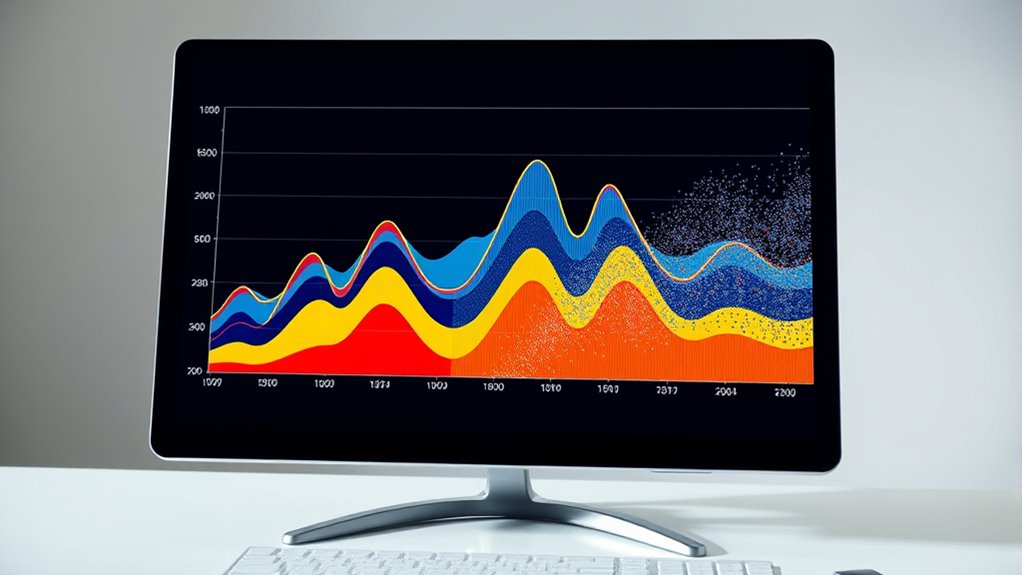

Time series decomposition helps you understand your data by breaking it into three main parts: trend, seasonality, and noise. The trend shows long-term movement like growth or decline, while seasonality reveals recurring patterns such as holiday sales or temperature changes. Noise represents irregular fluctuations caused by random factors. Recognizing these components allows you to interpret patterns clearly and improve forecasts. If you want to learn how to apply these techniques effectively, keep exploring further.
Play games included with Prime
Start a Prime free trial and play with Amazon Luna on your devices.
As an affiliate, we earn on qualifying purchases.
Key Takeaways
- Time series decomposition separates data into trend, seasonal, and residual components for better understanding.
- Recognizing trend reveals long-term data movement, while seasonality captures recurring patterns.
- Residual noise accounts for irregular fluctuations, helping identify anomalies.
- Proper decomposition enhances forecasting accuracy and detects underlying data behaviors.
- Selecting appropriate models like classical or STL ensures accurate component extraction and interpretation.

Time series decomposition is a powerful technique used to analyze and understand the underlying components of a data set collected over time. When you’re working with data that exhibits patterns or fluctuations, breaking it down into its fundamental parts helps you interpret trends, seasonality, and noise more effectively. The first step involves selecting the right model, which hinges on understanding the nature of your data and choosing appropriate decomposition methods. Different approaches, such as classical decomposition, STL (Seasonal and Trend decomposition using Loess), or more advanced techniques, offer various advantages depending on your data’s characteristics. Your goal is to identify which method best captures the underlying patterns without overfitting or missing critical signals.
Choosing the right decomposition method is key to uncovering meaningful patterns in time series data.
Model selection plays a essential role here. If your data shows consistent seasonal patterns, you might prefer STL for its flexibility and robustness. Conversely, for data with a clear, linear trend, classical decomposition could suffice. The key is understanding the strengths and limitations of each decomposition method. For example, classical methods typically assume additive or multiplicative models, which can simplify analysis but may not handle complex seasonal effects well. More sophisticated methods, like STL, allow you to adjust parameters for seasonal smoothing, making them more adaptable to real-world data that might have irregular seasonal patterns or changing trends over time.
Once you’ve selected the appropriate decomposition method, you can start breaking down your data into its components: the trend, seasonality, and residual noise. The trend component reveals the long-term movement, helping you see whether the data is generally increasing, decreasing, or stable. Seasonality captures recurring patterns—like increased retail sales during holidays or temperature fluctuations across seasons—that repeat over fixed periods. The residual noise represents the irregular fluctuations that can’t be attributed to trend or seasonal effects, often caused by random events or measurement errors. Recognizing the importance of model fit can improve the accuracy of your decomposition results.
Understanding these components allows you to make more informed decisions. For forecasting purposes, isolating the trend and seasonality enables you to model future values more accurately, while recognizing noise helps you gauge the reliability of your predictions. The entire process hinges on effective model selection and the right decomposition methods, ensuring your analysis is both precise and meaningful. With a clear grasp of these elements, you can refine your forecasts, detect anomalies, and gain deeper insights into the data’s behavior over time.
time series decomposition software
As an affiliate, we earn on qualifying purchases.
As an affiliate, we earn on qualifying purchases.
Frequently Asked Questions
How Does Decomposition Handle Irregular or Missing Data Points?
Decomposition techniques handle irregular or missing data points through robust handling methods, like data imputation or smoothing, which fill gaps or smooth out inconsistencies. You can use interpolation, forward-fill, or model-based approaches to manage data irregularities effectively. These methods guarantee the decomposition process remains accurate, even with incomplete or noisy data, allowing you to extract meaningful trend and seasonality patterns without being disrupted by irregularities.
What Are the Limitations of Classical Decomposition Methods?
Classical decomposition methods have limitations because they rely on strict model assumptions, like linearity and constant seasonal patterns, which may not fit real-world data. Outlier detection becomes difficult since these methods can be sensitive to anomalies, skewing the trend and seasonality estimates. Additionally, they often struggle with irregular or non-stationary data, making it hard to capture complex patterns accurately and reliably.
How Can I Choose the Best Decomposition Technique for My Data?
You should consider your data’s characteristics, like seasonality and noise, when choosing a decomposition technique. Start with data preprocessing to clean and normalize your data. Then, experiment with parameter tuning to find the best fit—for example, adjusting window sizes or seasonal periods. Compare results from methods like STL, classical, or X-13 to see which captures your data’s patterns most accurately and reliably.
Can Decomposition Be Applied in Real-Time Forecasting Scenarios?
Decomposition can be applied in real-time forecasting, like a chef adjusting a dish as they cook. You need algorithms designed for real-time adaptation, ensuring quick updates without sacrificing accuracy. Efficient algorithms are essential, allowing you to process data swiftly and respond to changing patterns. With the right methods, you can continuously refine your forecasts, making decomposition a valuable tool even in fast-paced, real-time scenarios.
How Do Seasonal Patterns Change Over Long Periods?
You’ll notice that seasonal patterns can change over long periods due to factors like shifts in consumer behavior or climate. Seasonal stability isn’t always guaranteed; patterns may evolve, fade, or become more pronounced. Tracking pattern evolution helps you adapt forecasting models accurately. By continuously analyzing these changes, you can better predict future fluctuations, ensuring your strategies stay aligned with the current seasonal dynamics and maintain relevance over time.
As an affiliate, we earn on qualifying purchases.
Conclusion
By understanding how to decompose a time series into trend, seasonality, and noise, you gain a clearer picture of the underlying patterns. This knowledge helps you make better predictions and informed decisions. Remember, knowing the ins and outs of your data is half the battle won. Once you master these components, you’ll be able to see the big picture rather than just a snapshot. Keep practicing, and you’ll be ahead of the curve in time series analysis.
As an affiliate, we earn on qualifying purchases.
As an affiliate, we earn on qualifying purchases.
Fall yard work Picks
leaf blowers
As an affiliate, we earn on qualifying purchases.