
In the Monty Hall problem, your initial chance of winning the car is 1/3. When the host reveals a goat behind one of the other doors, this new information changes the odds. By using conditional probability, you realize switching doors increases your chance of winning to 2/3. Understanding how the host’s constrained choice affects probabilities challenges your intuition. If you’re curious about how this surprising shift occurs, you’ll find some fascinating insights ahead.
Key Takeaways
- The Monty Hall problem illustrates how conditional probability updates the likelihood of winning after Monty’s reveal.
- Choosing to switch doors increases the chance of winning from 1/3 to 2/3 due to Bayesian updating.
- Monty’s constrained choice (never revealing the car) influences the probability distribution of remaining doors.
- Intuition often misleads because it ignores the conditional nature of information provided by Monty’s action.
- Proper understanding of conditional probability explains the paradox and guides optimal decision-making in the game.
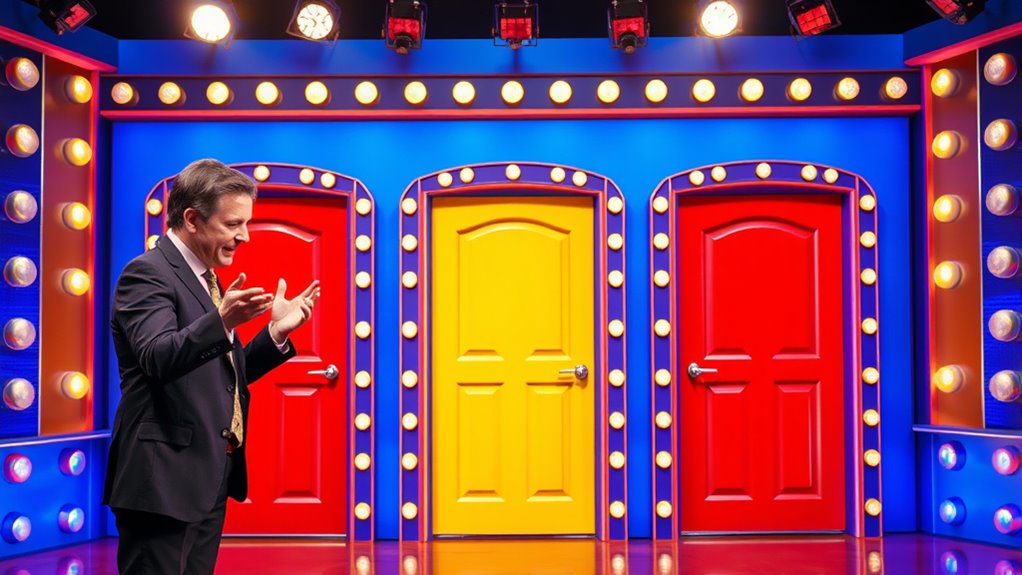
The Monty Hall Problem is a renowned puzzle that challenges your intuition about probability and decision-making. At first glance, it seems simple: you pick one of three doors, and then the host, Monty Hall, reveals a goat behind one of the remaining doors. You’re then given the choice to stay with your original pick or switch to the other unopened door. Many people instinctively think that switching or staying makes no difference, but in reality, the problem involves a subtle application of Bayesian updating and illustrates a classic probability paradox.
The Monty Hall Problem reveals how Bayesian updating can turn intuition about probability on its head.
When you initially choose a door, there’s a one-third chance you’ve picked the car and a two-thirds chance you’ve chosen a goat. After Monty reveals a goat behind one of the other doors—who knows where the car is—your initial probabilities need to be updated based on this new information. This is where Bayesian updating comes into play. Bayesian methods allow you to revise your probabilities in light of the host’s behavior, which is consistent: Monty always reveals a goat and never the car. Because of this, your probability of winning the car increases if you decide to switch doors, as the original probability that your first choice was correct (one-third) remains the same, but the probability that the car is behind the other unopened door jumps to two-thirds once the host’s reveal is factored in.
This scenario exemplifies a probability paradox because your gut feeling might say that switching doesn’t matter—after all, there are two doors left. But the statistics tell a different story. The key insight is that the initial choice had a lower probability of being correct, and Monty’s reveal effectively shifts the odds in your favor if you switch. The paradox arises because our intuition tends to ignore the conditional nature of the information provided by Monty’s action. In practice, Monty’s choice to open a specific door isn’t random; it’s constrained by his knowledge, so your decision to switch or stay should be based on the updated probabilities rather than initial impressions.
Understanding this problem in terms of Bayesian updating clarifies why switching is the better strategy. It’s not just a lucky guess but a rational response to the new information. The Monty Hall Problem is a perfect illustration of how conditional probability and probability paradoxes can defy intuitive judgment, reminding you to think carefully about the information at hand and how it influences the odds. Recognizing these principles helps you make smarter decisions under uncertainty, especially in situations involving incomplete information and strategic reveals. Additionally, this problem highlights the importance of correctly interpreting conditional probability, which is crucial in many real-world decision-making scenarios.
Frequently Asked Questions
How Does the Monty Hall Problem Relate to Real-World Decision-Making?
The Monty Hall problem relates to real-world decision-making by illustrating how you should approach risk analysis and strategic thinking. It shows that changing your initial choice can considerably improve your odds of success, encouraging you to re-evaluate assumptions. By understanding how additional information influences outcomes, you become better at making informed decisions under uncertainty, applying the same logic to business, investments, or everyday choices.
Can the Problem Be Applied to Modern Game Shows Beyond the Original Setup?
Imagine you’re in a modern game show, channeling your inner Monty Hall. You can definitely apply this problem’s logic to game show strategies today. Contestants and hosts use probability adjustments to influence outcomes, just like in the classic setup. This concept helps participants make smarter choices, whether switching or staying. So, even in current game shows, understanding the Monty Hall problem boosts your chances of winning, just like a vintage hacker in a 1980s arcade.
What Are Common Misconceptions About the Probability Outcomes?
You might think switching doors gives you a better chance, but your probability intuition can be misleading. Many believe each door has an equal 50/50 chance after Monty reveals a goat, which isn’t true. Intuitive reasoning often overlooks how conditional probability changes when new information is introduced. Remember, sticking with your original choice actually gives you a 1/3 chance, while switching improves your odds to 2/3.
How Does the Problem Illustrate the Importance of Bayesian Reasoning?
You see how the problem highlights Bayesian updating by showing that your initial guess isn’t enough; you need to adjust your beliefs based on new information. By understanding conditional probability, you realize that switching doors increases your chances of winning. This illustrates Bayesian reasoning, where you update your probability estimates as new evidence appears, making better decisions rather than relying on intuition or initial assumptions.
Are There Variations of the Problem With Different Numbers of Doors?
Yes, there are multi-door variations and probabilistic extensions of the problem. When you increase the number of doors, such as three or more, the initial probability of choosing the prize decreases, affecting your strategy. These variations highlight how probabilities shift with each choice, emphasizing the importance of understanding conditional probability. Exploring different numbers of doors helps you see how the underlying principles adapt to more complex scenarios.
Conclusion
So, now you see that switching doors in the Monty Hall problem really boosts your chances, just like upgrading from a flip phone to a smartphone. Remember, probability isn’t always intuitive—think of it as a vintage jukebox, where each choice impacts the next song. By understanding the conditional nature of the problem, you’re smarter than a game show host. Embrace the logic, and you’ll always play your cards wisely, even in a world full of surprises.