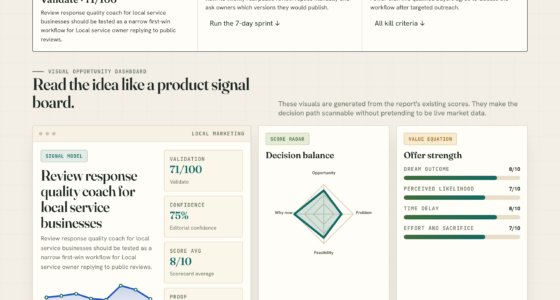
📊 Full opportunity report: Mastering Billing For Agencies: Blended Retainer And Usage Models Explained on IdeaNavigator AI — validation score, market gap, and execution plan.
TL;DR
Agencies are experimenting with a new billing approach that consolidates retainers, usage, and project charges into a single invoice. This development aims to streamline operations and reduce errors. Validation is underway with early testing among select agencies.
Digital and AI services agencies are piloting a new billing workflow that consolidates retainer, usage-based, and project charges into a single invoice. This development aims to address longstanding issues with manual invoicing, billing errors, and revenue leakage, and is supported by early testing among select agencies, according to IdeaNavigator AI.
The new billing approach involves a dedicated workspace where an operations manager can define a client’s billing components—such as a fixed retainer, a metered usage fee, and ad hoc project charges—and generate a single, consolidated invoice automatically each month. This system is designed to replace manual spreadsheet-based billing, which often leads to errors and time-consuming reconciliation.
Testing is currently underway with eight agencies, each modeling one real hybrid-pricing client. The goal is to validate the accuracy of the automated invoices against traditional hand-built spreadsheets and assess whether agencies are willing to switch to this new system. The pilot includes a subscription tier model based on the number of clients and a small percentage of invoiced volume.
Potential Impact on Agency Billing Efficiency
This new workflow could significantly reduce billing errors and operational overhead for agencies managing complex hybrid client arrangements. Automating the consolidation of multiple billing components into a single invoice can streamline revenue collection, improve accuracy, and free up staff time. If successful, it may influence the broader market for agency billing software, encouraging the development of more integrated, flexible solutions.
As an affiliate, we earn on qualifying purchases.
Growing Need for Flexible Billing Models in Agencies
As agencies increasingly bundle AI and digital services into retainers, traditional subscription billing tools fall short in modeling hybrid billing scenarios that combine fixed, usage-based, and one-off charges. Currently, many agencies manually stitch invoices together from spreadsheets, risking errors and revenue leakage. The rise of AI services and complex client arrangements has created a clear demand for more adaptable billing workflows. This pilot initiative responds directly to this market shift, aiming to validate a solution tailored to these evolving needs.
“This approach could transform how agencies handle complex billing, reducing manual work and errors significantly.”
— an anonymous researcher
automated invoicing system for agencies
As an affiliate, we earn on qualifying purchases.
As an affiliate, we earn on qualifying purchases.
Unclear Outcomes and Adoption Barriers
It is not yet clear how widely agencies will adopt this new billing model after testing, or whether the automated system will match the accuracy of manual spreadsheets in all cases. The pilot is ongoing, and detailed results are still emerging, with questions remaining about scalability and integration with existing accounting systems.
As an affiliate, we earn on qualifying purchases.
Next Steps in Validation and Market Adoption
The next phase involves completing the pilot with the eight participating agencies, analyzing invoice accuracy, and collecting feedback on usability. Success could lead to broader deployment and influence the development of agency billing tools. Further, vendors may incorporate similar features into their platforms, responding to the demand for flexible, automated billing solutions.
As an affiliate, we earn on qualifying purchases.
Key Questions
How does the blended billing model work?
The model combines a fixed retainer, a usage-based fee, and ad hoc project charges into one invoice, which is generated automatically using a dedicated billing workspace.
What are the main benefits of this new billing approach?
It aims to reduce manual effort, minimize billing errors, streamline revenue collection, and improve operational efficiency for agencies managing hybrid client arrangements.
Is this system ready for widespread adoption?
The system is currently in pilot testing with a small group of agencies. Its broader adoption will depend on pilot results, accuracy, usability, and integration capabilities.
Will this impact existing billing software providers?
If successful, the approach could influence the development of new features in agency billing platforms, encouraging more flexible and automated invoicing solutions.
What challenges might agencies face in adopting this system?
Potential challenges include integrating with existing accounting tools, ensuring invoice accuracy across complex billing components, and convincing agencies to transition from manual processes.
Source: IdeaNavigator AI